Capping Stunts Massey University
CAPPING STUNTS
OF MASSEY UNIVERSITY
Centennial Edition
A Chronicle of Ingenuity, Audacity,
and Occasional Structural Relocation
Compiled and formatted by Gerald Rys, B.Agr.Sci (Hons), Massey University, 1974
"In the annals of human achievement, there are those who moved mountains, those who moved nations, and those who moved a phone box onto the university concourse and left a pumpkin in its place."
— Anonymous Massey Graduate, c. 1985
Preface......................................................... 3
Chapter 1: What Is a Capping Stunt?............ 4
Chapter 2: Urban Interventions.................... 5
Chapter 3: Iconic Objects Re-sited................ 7
Chapter 4: Vertical Theatre.......................... 8
Chapter 5: Animals and the Absurd.............. 9
Chapter 6: The Media as Stage.................... 11
Chapter 7: Procesh 1935 to 1988 ................ 12
Chapter 8: Double-Bluffs............................ 16
Chapter 9: High-Risk Legends.................... 17
Chapter 11: Campus-Only Capers................ 19
Chapter 12: The 1990s and After................. 21
Afterword: Preserving the Spirit................. 24
The Code of Conduct for Sanctioned Whimsy………………………………………………………….25
Acknowledgements..................................... 27
Preface
This volume documents a distinctive strand of New Zealand's student folklore: the capping stunt. What follows is drawn largely from Massey University alumni recollections from the late 1960s through the 1990s—and illustrates the creativity, wit, and occasional structural violations that accompanied graduation season.
The objective is documentary: to preserve memories, provide context, and prompt critical reflection on safety, ethics, and the eternal question of why anyone thought releasing chickens numbered 1, 2, 3, and 5 into a library would be amusing. (It was, of course, because everyone spent hours looking for chicken number 4, which did not exist.)
Readers should note that many incidents occurred in an era of looser regulation and different social expectations—a time when a student could borrow municipal infrastructure overnight without necessarily facing legal charges. This book does not endorse illegal or unsafe activity. It merely observes, with a mixture of admiration and alarm, what happens when agricultural or other students have free time.
How to Read This Book
Each chapter groups related stunts and provides a narrative synthesis, historical context, comprehension prompts for the academically inclined, and safety notes for anyone considering revival efforts. An index of people, places, and years is included at the end, though individuals associated with specific stunts are not identified—partly to protect the innocent, and partly because some participants have since become pillars of their communities who would prefer not to explain to their grandchildren why they once dressed a giant commercial kiwi statue in nappies.
Chapter 1: What Is a Capping Stunt?
"The best stunts required the precision of a military operation, the creativity of a theatre company, and the moral flexibility of a politician."
New Zealand universities developed a tradition of elaborate student pranks—typically during May graduation—aimed at surprising the public, lampooning authority, and showcasing ingenuity. At their best, these stunts relied on wordplay, theatricality, and coordination that would have impressed NATO logistics officers. At their worst, they risked public safety, damaged property, or prompted the kind of emergency council meetings that begin with someone sighing heavily and saying, "The students again."
The capping stunt occupied a peculiar position in New Zealand's cultural landscape: simultaneously celebrated as evidence of youthful creativity and dreaded by municipal authorities who had learned to increase security around anything removable during graduation week. Over time, Massey University and the local authority placed firmer limits on activities, contributing to the decline of large-scale stunts in many locations —though whether this represents the triumph of health and safety or the death of imagination remains a matter of spirited debate in certain pubs.
Targets, Methods, and Motivations
The preferred targets of student ingenuity included civic spaces (the Square, bridges, clock towers), councils (particularly the long-suffering Palmerston North City Council), university facilities, media organisations, and occasionally hospitals—though the latter were generally approached with more restraint, or at least smaller livestock.
Methods ranged from the subtle (conflicting anonymous tip-offs designed to create confusion between authorities) to the spectacular (relocating entire roundabouts). Common techniques included misdirection, parody signage, kinetic floats, synchronised hoaxes, and the strategic deployment of garden gnomes.
The golden era stretched roughly from 1969 to 1994, with Palmerston North and Massey University serving as the epicentre of activity—possibly because agricultural students had access to tractors, or possibly because there is only so much entertainment available in Palmerston North and one must create one's own.
Chapter 2: Urban and Other Interventions
Roundabouts, Islands, and the Art of Municipal Relocation
"We didn't steal the roundabout. We merely facilitated its relocation without prior written consent from stakeholders."
A signature Massey motif was the covert reconfiguration of urban furniture. In 1985, a temporary roundabout at Albert and Ferguson Streets was disassembled overnight and reconstructed one block over at Victoria and Ferguson. The audacity lay not merely in moving the concrete pavers and give-way signs, but in executing the swap with borrowed household equipment and impeccable timing—the kind of logistical achievement that would look impressive on a CV if only it weren't also illegal.
A driver struck the improvised structure at dawn, transforming the prank from amusing to legally complicated in the space of a heartbeat. The incident became local lore—and a cautionary tale about the difference between "technically possible" and "advisable."
The following photos are of a further stunt on Church St (about 1973), a formal dinner on the roundabout, a couple of photos of the dinner in full swing including playing on a piano (which came and went in a van). The other photos are of being asked by the Police to move on (the evidence). It was agreed that we could finish our dinner, then we sang auld lang syne and took the furniture back to a participants’ flat through gaps in the traffic. No roundabout removal, just augmentation.
|
|
|


|
|
|


The Logistics of Mischief
What makes these interventions remarkable from an engineering perspective is the precision required. Moving a roundabout is not like moving furniture. It requires tools, transport, and the kind of coordinated timing that suggests either military training or an extremely well-organised pub quiz team. The fact that these operations succeeded at all speaks to either remarkable competence or remarkable luck—quite possibly both.
Odd Statues Adorned by Students
|
|
Like in
2015, when the Albany Massey Engineering Student
Society plastered a huge KFC-inspired bucket on the Albany Chicken
Wing statue. |

Chapter 3: Iconic Objects Re-sited
Phone Boxes, Gnomes, and the Philosophy of Displacement
"Comedy is tragedy plus time. Also, tragedy plus one phone box appearing where no phone box should be."
The Phone Box and a Pumpkin
|
The red phone box not the tardis which is blue |
Capping
stunts often hinged on the visual shock of a familiar object appearing
somewhere profoundly wrong. One morning in the mid-1980s, Palmerston North
residents found a red phone box missing from its corner—reappearing
conspicuously on the university concourse, with a lone pumpkin left on the
original plinth as a visual punchline. The pumpkin, it should be noted, made
no attempt to provide telephone services. |
Exhibit A in numerous theoretical discussions |


Gnomesville
|
In another
widely remembered act dubbed "Gnomesville," garden gnomes from
around the city were mustered in the Square with a sign inviting owners to
reclaim them. Radio hosts joined the theatre by encouraging residents to
retrieve their property, creating a spontaneous community event in which
citizens shuffled through assembled gnomes looking for familiar faces—a
sentence that sounds absurd until you consider that garden gnomes often do
develop a certain familiarity through years of silent garden surveillance |
Gnomes: the foot soldiers of
student mischief
|

Chapter 4: Vertical Theatre
Towers, Clockfaces, and the Pursuit of Altitude
"If you're going to make a statement, make it somewhere people have to look up. Literally and figuratively."
Tower Antics
|
Elevation amplified impact.
Alumni recall a bicycle placed atop the Palmerston North clock tower—replaced
after removal in a running gag reminiscent of Glasgow's well-known
traffic-cone capers. The bicycle-tower combination proved so popular that
authorities eventually stopped removing it immediately, having calculated
that the removal effort exceeded the publicity benefit of appearing stern. Clock tower: silent witness to
numerous ascents |
|
||
|
|
Legend: the dismantled car
Allegedly
reconstructed on the Vet Tower. One pauses to consider the logistics:
disassembling a car, transporting its components to elevation, requires not
merely determination but a fundamental disregard for how one might spend a
weekend. The car, reportedly, was not driveable from its new position—though
one suspects this was not a design goal. Car and a lot of parts |
|
|


The Yeti Footprints
|
Large
"yeti" footprints tracked down Fitzherbert Avenue, over the bridge,
and towards campus—a masterpiece of absurdist geography suggesting that
cryptozoological creatures, should they exist, would naturally be drawn to
agricultural universities. The footprints reportedly caused brief
consternation among residents before the graduation context became apparent. Evidence of cryptozoological
visitation (allegedly) |
|

Liquid Courage
In another altitude defying stunt, that may or may not be
true, a student after a late night at the Fitzherbert Pub and much the worse
for wear, decided to attach a protest note to the top of a crane building one
of the new University multistorey towers. After achieving the feat at the
urging of fellow conspirators, they all went home to sleep it off. On
arriving back at the scene of the stunt the following morning, the individual
involved turned as white as a ghost and threw up, as his colleagues marvelled
at the audacity and height of his stunt.
|
|

The Cardboard Catastrophe
|
|
A
spectacular (and disruptive) variant involved releasing a truckload of empty
cartons onto Fitzherbert Bridge at rush hour, creating gridlock "around
the Square" and out towards Linton. This particular stunt illustrates
the thin line between "memorable" and "actually causing real
problems for people trying to get to work"—a line that, in retrospect,
was clearly crossed. |

Chapter 5: Animals and the Absurd
Chickens, Sheep, and the Limits of Zoological Comedy
"The chickens were numbered 1, 2, 3, and 5. The genius was in the absence."
Hens Play
|
|
Playful
surrealism featured often in capping repertoire. The library chicken incident
stands as perhaps the purest expression of mathematical humour in prank form:
four loose chickens labelled "1, 2, 3 & 5" ensured that
searchers spent considerably more time hunting for the mythical "4"
than actually catching the existing birds. The prank exploited human
pattern-seeking behaviour with elegant simplicity—and minimal chicken-related
property damage. |

Sheep Adventures
|
In the
1970s, sheep came to the fore. Stunts describe sheep travelling by lift to
the top floor of Walter Dyer Hall—an experience the sheep presumably did not
request but seemed to tolerate with characteristic ovine stoicism. Ewes: surprisingly tolerant of
elevator travel, rams less so. |
|

The Evolution of Animal Standards
These stories highlight dramatically changed norms around biosecurity, workplace safety, and animal welfare. Modern replication would be inadvisable, illegal, and probably quite stressful for the animals involved. The chickens and sheep of the 1970s have since been succeeded by more symbolic forms of absurdism, which is probably better for everyone except those who enjoy very literal interpretations of agricultural education.
Chapter 6: The Media as Stage
Hoaxes, Headlines, and Manufactured Reality
"The truth is whatever appears in enough newspapers simultaneously”
The Flying Saucer
|
Students
sometimes turned newspapers and radio into unwitting co-performers. A
celebrated national example—originating at Otago in 1952—involved a
synchronised "flying saucer" report, with participants timing calls
and letters from around the country to simulate a southbound UFO flight path.
The coordination was remarkable: sightings were reported from the North
Island, then progressively southward, creating an apparent trajectory that
newspapers faithfully documented. The 1952 UFO
hoax represents perhaps the most sophisticated media manipulation in New
Zealand student history—predating social media virality by half a century but
demonstrating the same principles. When multiple independent sources report
the same impossible thing, the impossible briefly becomes the official
record. |
The 1952 UFO trajectory: cartography meets creative fiction |

The Tasman Swim
|
|

The Fake Speed Camera
|
In the
1990s, an engineering-style "fake speed camera" on Massey's Ring
Road prompted parental calls to police about supposed fines. The device was
convincing enough to generate genuine anxiety—a reminder that the line
between "prank" and "causing actual stress to (not so) innocent
people" requires careful consideration Speed cameras: easy to
replicate, ethically complicated |
|

Brassed Off
|
|
One classic stunt was to polish just the private
parts of a naked brass statue. When wardens came around the next morning,
they were confronted with the partially gleaming statute. This would
immediately require a panicked council to send around a dozen workers to
polish the whole of the brass statue to the same standard as the original
polish. This had to be done quickly before the media and public found out. |

The Bambina Stunts
|
|
There size and
weight always made them a very inviting target. The bambina in
the bin and the bin in the bambina. |
|


Chapter 7: Procesh (1935–1988)
The Glory Days of Organised Chaos
Procesh floats: ambition exceeding available materials
For over fifty years, Massey students inflicted their annual capping parade upon the good citizens of Palmerston North. Pranks are a national pastime, a delight! From stationery floating in jelly to classic gladwrap gags, pranks sustain students through the misery years of university. Known as "Procesh," this rolling carnival of questionable taste first lurched down Fitzherbert Avenue in 1935, ostensibly to raise money for charity—a convenient justification for whatever followed. Photos of the early days of Procesh can be found here. Procesh | Massey University Library
The parade would snake from campus to The Square, culminating at the band rotunda where speeches were delivered to crowds of varying enthusiasm. To squeeze a few more coins from spectators, students began hawking Masskerade magazine in 1939—a publication that would later achieve the distinction of being declared indecent for anyone under 16. Issues of Masskerade can be found following. Masskerade | Massey University Library
Initially, Palmerston North tolerated the spectacle with good humour. The relationship soured over the decades as "student antics" evidently evolved beyond what ratepayers considered acceptable entertainment on a Thursday afternoon.
By the 1970s, however, the magic was fading—floats became half-hearted, behaviour deteriorated, and public interest waned accordingly.
The final nail came in 1988 when the City Council and Police imposed restrictions that MUSA deemed unworkable. The frequent use of wholesome eggs may have been a major contributor. Rather than stage a neutered version, the Students' Association pulled the plug entirely.
And so ended an era when agricultural students could commandeer the main street of a provincial city once a year, and everyone more or less went along with it
Floats, Blood Pumps, and Applied Theatrical Engineering
"We built a horse. Then we gave it colic surgery. With recirculating intestines. What of it?"
"Procesh" provided a sanctioned spectacle, and students rose to the occasion with industrial enthusiasm
The theatrical ambition on display was remarkable. These were not simple floats but functioning mechanical systems, built by students who had apparently decided that if veterinary surgery was going to be simulated, it would be simulated with proper hydraulics.
|
Recollections
include a papier-mâché horse undergoing "colic surgery," complete
with staged intestines and recirculated fluid from 44-gallon drums. A
secondary "blood fountain" fitted with a swivel nozzle allegedly
misted crowds—an engineering achievement that, in retrospect, raises
questions about what precisely was being taught in those fluid dynamics
courses. |
|

Student Fascination with Fire
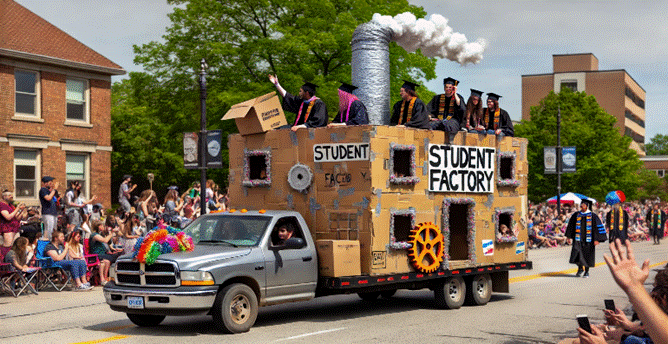
In one procesh in the early seventies, a group of students decided to produce a float called the “Student Factory”, dressing up the float to look like a factory with a real smoking chimney. The rest was put together with cardboard and battens. However, the design including chimney, lacked any sophisticated engineering design to ensure health and safety on the trip. The smoke was created by burning diesel in a paint tin funnelled into a multilayered paper tube. Armed with eggs for pelting fellow floats, they set off. Halfway around the route, the smoke levels started to increase. On closer inspection, flames were seen inside and outside the chimney. Alarms were sent out (no cell phones those days) for fire extinguishers and/or the fire brigade. Fire extinguishers arrived and the fire put out, but the fire brigade to be sure, sprayed sufficient water to fully destroy the cardboard float and escort the float back to the starting point.
Float Engineering
|
Other floats
parodied popular culture—"Gums" (a toothless take on
"Jaws"), "Holly's Habits" (religious
satire)—demonstrating that the brief format of a parade float could
accommodate surprisingly sophisticated commentary, provided one was willing
to commit to papier-mâché at industrial scale. The Alpine Club was always
seeking to scale to great heights with their float. |
The Alpine Club contribution:
altitude-themed naturally |
|
|
|
|
Political Satire
Satire, humour and political commentary were never far
from the floats that made up Prosech each year. Numerous vehicles were “donated”
from various sources and hurriedly put together. Float themes were
constructed, with limited structural safety. Procesh float: ambition
exceeding available material |
||
Odds
and Ends Stunts
·
When PM Kieth Holyoake and Aussie PM Gorton visited
Massey they were escorted on to a rickety raft on the Massey lake and Lord
Massey sold NZ to Aussie for a leg of lamb and a pound of butter. · To promote
sales of the capping magazine “Masskerade,” in 1966 a group of us
walked backwards from Wellington to Palmerston North and the following year
we did it on stilts. |
·
One year we hoisted bicycles up all 14 flagpoles
on buildings around the Square including the Clock Tower. · I suppose
my own personal greatest stunt was when we gave the Massey University to
Queen Elizabeth as a new colony. As Tom Scott recalled in the Listener “The
Queen endured Lord Massey’s somewhat slurred and nervous proclamation with a
nervous smile, while further back Prince Phillip stood, grinning broadly and
saying things like: “Bloody good show.” |
||


Chapter 8: Double-Bluff
The Art of Manufactured Confusion
"The most elegant pranks require no props—only phone calls and impeccable timing."
Police and Workmen
|
A classic
script exploited divided authorities: warn road crews that "fake
police" would interfere with their work, while alerting police that
"fake road workers" planned to dig up the street. Each group,
primed against impostors, meets the other with suspicion. The spectacle is
the confusion itself—a self-generating situation requiring nothing more than
two telephone calls and an understanding of institutional psychology. |
Authority figures: reliably
suspicious when warned to be |
|
|
Road workers: often caught in
the middle of elaborate schemes |
The elegance
lies in the pre-planning: credible detail, appropriate timing, and the
fundamental human tendency to believe warnings about things that sound
plausible. The risk lies in real-world consequences—delayed services, traffic
hazards, or confrontations between genuinely confused public servants. |
|


The Double Bluff
What distinguishes the double-bluff from simpler interventions is its economy. No roundabouts, need relocation. No livestock requiring transport. The entire apparatus consists of communication and timing—a reminder that the most effective pranks often exploit systems rather than objects.
Chapter 9: High-Risk Legends
Bronze, Helicopters, and the Boundaries of Folklore
"The best stories may or may not have happened. The important thing is that someone believes they did."
Anecdotes from the late 1970s describe students mobbing Ballantynes, with a heavy bronze sculpture "mysteriously" removed and later reappearing as a prize in stunt competitions. Some recall rumours of a "stolen helicopter" in the same season.
Kiwis can Fly
|
The Kiwi
Bacon Company kiwi atop the DIC (now the Plaza) building in the Square
was dressed in nappies. |
|

Whether these tales represent actual events, exaggerated memories, or pure invention is difficult to determine decades later. What matters is that they persist—passed down through generations of students as evidence of what was once possible, or at least what people once believed was possible.
The Function of Dangerous Legends
The most hazardous tales serve a particular cultural function: they establish an outer boundary of achievement against which subsequent efforts can be measured. Even if the helicopter was never actually stolen, the story that it might have been creates a reference point for ambition. This is folklore doing what folklore does—establishing mythology rather than documenting history. Modern practitioners should treat these tales as archaeology rather than an instruction manual. They belong in the study of student culture, not in any repertoire for revival. The line between "legendary" and "criminally prosecutable" has not shifted in the students' favour.
Chapter 10: Slogans and Military Equipment
When Agricultural Students Met the Armed Forces
"God Save NZ Because the Army May Not."
Army Trucks
|
Earlier
memories include agricultural students entering the Linton Army Camp and
driving a military truck into the Palmerston North Square, emblazoned with
that memorable slogan about national defence capabilities. One appreciates
the political commentary while noting that modern military installations have
more robust security protocols. |
|

The Security Implications
These episodes would, today, raise immediate security and safety alarms. Military property is no longer accessible for recreational borrowing, and for good reason. The stunts documented here should be understood in their historical context: a time before terrorism awareness training was part of standard institutional life, and when a truck appearing in an unexpected location was assumed to be students rather than something more concerning.
Chapter 11: Campus-Only Capers
When the Prank Stayed Home
"A Mini car in the library foyer is funny. A blocked fire exit is a liability. We learned to distinguish."
Flying Minis
|
|
Campus-bounded
stunts included a Mini car tipped on its side and wedged through the library
doors into the foyer, tractors lined across the concourse, and the
gold-painted toilets in the Vet Tower. Their humour owed much to incongruity
and scale: industrial machinery indoors; a vehicle where only books should be |


Ring a Ring a Rosy
|
One classic
prank was the diverting of all main road traffic around the Massey ring road.
This was possible as the entrances are not visible to each other. The stunt
had been carefully staged early in the morning with a number of “slow down”, “this
way” and “low speed” signs appeared, acquired over the previous weeks. The
major impact was large trucks changing down numerous gears on the ring road,
waking up students in the near by student hostels in the early morning. This
carried on for nearly a morning before authorities realised what had
happened. |
Massey Ring Road. The circle of death. |


The Golden Throne
|
Campus installations saw toilets in the
Vet Tower painted gold "like thrones," reportedly to a dean's
consternation. The intervention combined accessibility (everyone uses
bathrooms) with visual absurdity (few expect them gilded) in a way that required
minimal technical skill but maximum audacity. The gold paint, sources
suggest, proved difficult to remove. |
|

These pranks represented a particular category: ambitious but contained. By remaining on university property, they avoided the most serious legal complications while still achieving the essential goal of making authority figures sigh heavily and reach for their telephones.
The Risk Assessment Question
Even on private grounds, modern health and safety frameworks would prohibit obstruction of exits or heavy objects in public egress routes. The Mini in the library, charming in memory, would today generate incident reports, risk assessments, and possibly consultation with structural engineers regarding load-bearing capacity of foyer floors.
This represents the broader trajectory of capping culture: from an era where "nobody got hurt" was considered sufficient justification, to one where "nobody could theoretically get hurt in any foreseeable scenario" is the minimum standard.
Chapter 12: Medical misadventures
Medicine meets mortals: how to infuse humour
“Hospital staff have long understood that laughter is the best medicine—though they probably didn't anticipate students would prescribe it in such generous doses”.
The 1970s brought livestock
liberation allegedly escorted into hospital
kitchens. The details remain murky, possibly because participants recognised
that "I once put a sheep in a hospital" is a confession best kept
vague. This stunt proves that
nothing says "institutional catering" quite like a bewildered sheep
among the pots and pans. One imagines the cook's report: "Dinner will be
late—we're still rounding up the entrées."
|
|

The streakers who crashed the nursing shift change took the concept of "patient exposure" to unprecedented levels. Handcuffed and lined up for inspection, they provided an anatomy lesson that wasn't on any curriculum. The incoming nurses got quite the handover briefing: "Room 4 needs obs, and the corridor needs trousers."
Wees
|
|
Students who distributed
notices warning of contaminated bananas—requiring citizens to deliver urine
samples to the post office—achieved something remarkable: they got NZs to
queue politely while carrying bottles of wee. The postal workers, accustomed
to handling parcels and complaints, found themselves confronting an entirely
new category of customer service. "First class or standard delivery for
your sample?”
|

Coffins and Tyres
Perhaps the finest theatrical
production involved a hearse, a flat tire, and impeccable comic timing.
Dressed as morticians, students removed a coffin to access the jack in the
hearse, changed the tire with solemn efficiency, then drove away—leaving the
casket sitting on the pavement like forgotten luggage. The image of
pedestrians shouting "You've forgotten something!" at a departing
hearse captures the absurdist Genius perfectly. What exactly is the etiquette
when returning a misplaced coffin?
|
|
ODDS AND ENDS STUNTS
·
Pranks are a national pastime, a
delight! From stationery floating in jelly to classic gladwrap gags, pranks
sustain us through the misery years of university.
·
At Vic Uni, a
letter was circulated warning that the water supply dam above Wellington
would burst unless every hydrant and tap in the city was opened to relieve
the pressure. Again, people complied!
·
Other capping stunts have allegedly involved a
Massey student “stealing” a bus full of Japanese tourists to enter it in a
lost and found contest
· Dunedin students
stuck notices on parked cars advising them that their types needed to be
brought into the local council due to chemical spray on the road. Auckland students snuck dry ice
into 44-gallon drums, spray painted with hazard symbols, and subsequently
rolled off a truck in the CBD.
|
·
In 1969, a pirate student radio, bFM, was created
and broadcasted from a boat aground in
Auckland's Waitematā Harbour. The station was played illegally on
speakers all around Auckland University (fun fact: the b originally
stood for bosom)!
·
Students altered the size of carparks so they were just a
touch smaller.
|

Chapter 13: The 1990s and After
From Street Theatre to Digital Age
"The medium changed. The impulse to cause organised confusion remained constant."
By the 1990s and 2000s, stunts increasingly referenced contemporary culture and technology.
King Kong Mischief
|
In a 2004
stunt students staged fake auditions for extras in Peter Jackson's King Kong,
with over 200 students auditioning for non-existent parts. Participants
signed disclaimers and performed "funny walking" and facial
expressions. One group sang Monty Python's Always Look on the Bright Side of
Life in various styles. These illustrate a pivot from physical rearrangement
of the city to media-centred spectacle and consent-ambiguous
"experiences." The ring of cinema fame proved more effective than
any traffic island for gathering crowds. No students received the call to act
in King Kong. |
|

The Ethics of Participation
The fake audition raises questions different from those of earlier stunts. Moving infrastructure harms the public abstractly; inviting people to participate in a fiction potentially harms them specifically. When someone travels across town for an audition that doesn't exist, their time and hope have been invested in something deliberately false. This represents perhaps the evolution of capping culture's ethical challenges: from property and safety concerns to questions of consent, dignity, and the appropriate treatment of fellow citizens in the pursuit of amusement.
Chapter 14: Afterword: Preserving the Spirit
Imagination Meets Responsibility
"The goal was never chaos. It was surprise, wit, and the proof that creativity survives bureaucracy."
The ingenuity celebrated here—puns, props, timing, teamwork—need not vanish with stricter rules. Universities and councils can co-design sanctioned creative events: temporary public-art installations, licensed parade theatre, campus-contained game-design festivals, and performances that achieve spectacle without endangerment.
The spirit survives where imagination meets responsibility. The chicken-numbering gambit requires no property damage apart from cleaning up afterwards; the double-bluff script, rewritten as opt-in theatre, could function as performance art. Even the gnome-gathering concept could return with pre-arranged volunteers rather than unwitting victims.
What matters is the underlying impulse: the belief that public space can be temporary canvas, that institutions deserve gentle mockery, and that graduation is worth celebrating with something more memorable than a handshake. These values can flourish within legal frameworks—they simply require more creativity in execution, which was always supposed to be the point.
A Note to Future Generations
If this volume serves any purpose beyond documentation, it is to remind future students that creativity and ethics are not opposed forces. The best stunts were never the most destructive; they were the wittiest, the most carefully planned, and the ones that left audiences impressed rather than inconvenienced.
The roundabout movers of 1985 are grandparents now. Their legacy is not the relocation itself but the proof that students could coordinate, problem-solve, and execute ambitious plans—skills that presumably proved useful in their subsequent careers, though probably applied to different objectives.
The transition from historical "civil transgression" to contemporary "sanctioned creative theatre" requires a robust governance framework. The following Code of Conduct for Sanctioned Whimsy is designed to balance the intellectual wit of New Zealand university folklore with the modern legislative requirements of the Health and Safety at Work Act (HSWA) 2015.
The Code of Conduct for Sanctioned Whimsy
I. Preamble
This code recognises that the "capping stunt" is a distinctive strand of New Zealand student folklore, celebrating creativity, wit, and coordination. Our objective is to preserve this tradition by ensuring imagination meets institutional responsibility.
II. Core Operational Principles
1. Structural and Infrastructure Integrity
- Engineering Approval: No objects (e.g., bicycles, vintage cars) may be placed on landmarks or university structures without formal engineering sign-off.
- Egress Maintenance: All installations must maintain 100% clear fire exits and emergency access at all times; modern frameworks prohibit the obstruction of public egress.
- Urban Furniture: Interference with road layouts, signs, or public infrastructure is prohibited. Any "reconfiguration" must be performed as a sanctioned installation on a closed campus with a Traffic Management Plan (TMP).
2. Biological and Chemical Safety
- Animal Welfare: The use of live animals in stunts (e.g., chickens in libraries or sheep in lifts) is strictly prohibited to maintain biosecurity and workplace safety.
- Safe Substitutes: Props, puppetry, or approved therapy animals with strict oversight are the only permitted biological analogues.
- Fluid Dynamics: Any "blood pumps" or misting effects used on parade floats must utilize food-grade or theatre-safe fluids within barricaded routes.
3. Ethical Engagement and Consent
- Transparent Framing: Media-based hoaxes or "spoof tech" (e.g., fake speed cameras or film auditions) must include explicit disclaimers and opt-in participation.
- Official Impersonation: Students must never impersonate officials (e.g., police or road workers) or misdirect emergency services.
- Double-Bluff Logic: Creative scripts involving divided authorities must be replaced with council-approved performances clearly marked as theatre.
III. The Risk-Whimsy Assessment Matrix
This matrix is to be used by Student Associations to triage proposed stunts before submission to University deans or City Councils.
|
Whimsy Level |
Historical Precedent |
Risk Profile |
Action |
|
High |
The "Chicken #4"
Pattern-Seek |
Low (Psychological) |
Approved (with prompt clean-up plan). |
|
High |
"Gnomesville"
Displacement |
Low (Consent-based) |
Approved (with documented provenance). |
|
Critical |
Reconstructing cars on Vet
Towers |
Extreme (Structural/Fall) |
Modified (Light projection only). |
|
Critical |
Relocating Roundabouts |
Extreme (Public Safety) |
Prohibited (Template for folklore study
only). |
IV. Documentation and Folklore Preservation
To document these acts responsibly without glamorising harm, curators must:
- Contextualise: Use wide establishing shots to show the urban or campus context of the installation.
- Highlight Craft: Capture the mechanism (e.g., rigging or pumps) to demonstrate technical ingenuity and safety compliance.
- Respect Privacy: Secure permissions for logos and blur identifiers where required.
V. Institutional Endorsement
By adhering to this code, we ensure that the "capping stunt" remains a celebrated part of New Zealand's academic history—documented for its wit rather than its hazards.
"The spirit survives where imagination meets responsibility."
Acknowledgements
This manuscript is compiled from alumni recollections and notes supplied by Dr Gerald Rys, Massey Alumni. Specific incident summaries derive from contributed documents, oral histories, and the institutional memory of those who were present when the roundabout went missing.
Where recollections conflict—and they frequently do, because memory is unreliable and enthusiasm distorts detail—conservative phrasing is used and dates are presented as indicative rather than definitive. The chicken definitely existed. There were probably four of them. The numbering scheme is well-documented. Beyond that, certainty fades including whether they were ever recaptured.
Contributors whose recollections informed this volume include (alphabetically): Bruce Harold, Daniel Webber, Duncan Bennet, Fiona Dalzell, Jane Wilson, John Troutbeck, Juliette Bowater, Max Suckling, Irene and Denis Thomas, John McGill, Nick Nicholas Robinson, Paul Chilvers-Grierson, Quentin Smart, Richard Pester, Roger MacBean, Stuart Campbell, Alan Walker, Tim Wood, Timothy O'Neill and many more who wish to remain anonymous.
Also acknowledgments to the Massey University Archives Library from where some of the photos are sourced. Archives and Special Collections at Massey University | Massey University Library
Any errors of fact, interpretation, or emphasis are the editor's responsibility. Any errors of judgment in the original stunts are firmly attributed to the participants, who mostly knew better and did it anyway.
Should anybody be put out that we have missed your favourite stunt, you can forward an email to cappingstuntsnz@gmail.com with details. If you have actual photos of stunts these would also be much appreciated. The end. Regards Gerald

Student Sunset Parade After Graduating
